Litter – a children’s story

Someone to whom I read this story suggested that it ought to be a children’s story, and so I rewrote it and added illustrations. It is set up to be on 5.5” by 8.5” paper with the appropriate illustrations facing the text. I couldn’t make this work on this blog and so the illustrations which ought to face the text follow it. I hope that this isn’t too confusing for bloggers. I invite my adult blog readers to offer suggestions on how to make it more attractive for a younger audience.

**********

Madi and Josiah were going on caravan holiday at a beach in west Scotland. It was a long drive from home. When they arrived at the Cameron farm where they planned to camp they got out of their car. They were tired, stiff, and excited. Their father asked them and their mother to stay beside the car while he crossed the farmyard to greet Mr. Cameron.

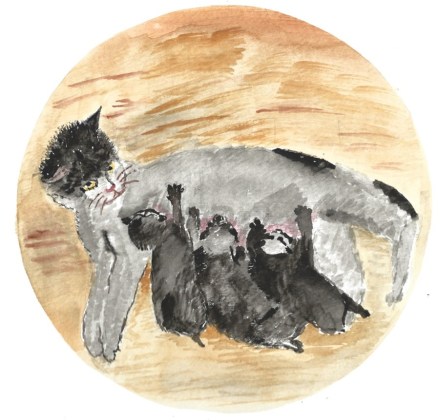
They stood and stretched and gazed at the farmyard. Presently Madi saw a black and grey cat which lay in the entrance to the barn feeding a litter of kittens. She pointed the cat out to her mother and to Josiah. They watched and listened to the cat purring and the gentle sound of the kittens sucking.

Soon the men shook hands and their father returned to them. He looked happy and asked them to get back into the car. While they were getting in he spoke,

“Our camping spot is in a field up here on the left.

During the week we will have the beach to ourselves. There will be day-trippers on the weekend but they will park in the field on the right. We can get water, fresh eggs and milk from the farm. It is idyllic!”

kittens

How many kittens were in the litter?

**********

When they were back in the car he turned and smiled at his wife, and then leaned back to face his children. “This place is heaven,” he beamed, “and, oh yes, Mr. Cameron is most particular about litter. We must be careful not to leave any. The cove is beautiful, and he wants to keep it unspoiled. He says that the weekend day-trippers are a problem and asks that we help pick up after them. I told him that we didn’t mind having a holiday chore!”

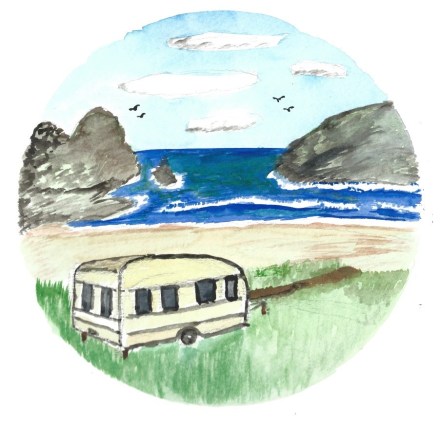
After the caravan was parked and unhitched from their car their father carefully leveled it. It stood on springy marine shore grass a few feet from the beach. Then he took Madi and Josiah down to the shore to play. They paddled in the water. It was icy cold. Their mother stayed behind to prepare supper.

CARAVAN

Can you count the birds in the air?

**********
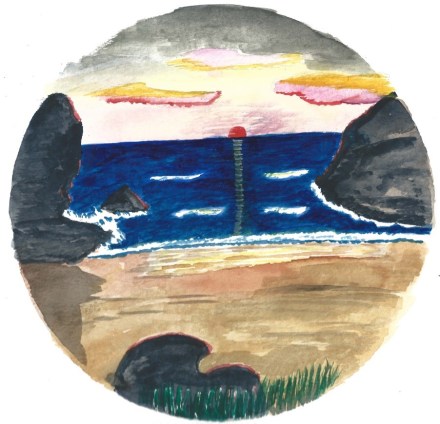
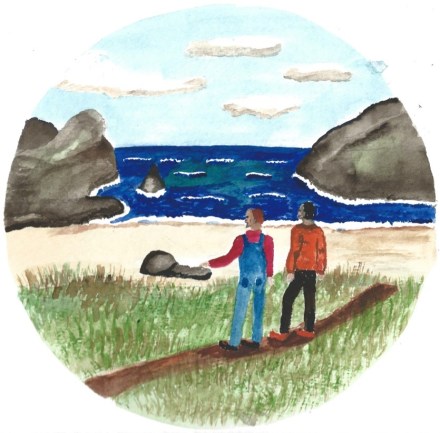
After supper their father went outside and sat on the caravan steps. He breathed deeply and gazed at the view before him. It was close to sunset and the sun hung low in the sky as it approached the spot where it would dip into the waters of the horizon.

Madi, Josiah and their mother joined him. They sat on a blanket and ate Smarties as they watched the sun set. They breathed in clean salty air and savored the peace of nature and the happiness of their loving family.

BEACH

Can you find the sun?

**********

Three days later the day-trippers arrived. Mr. Cameron spent most of the day standing at the gate into his field parking lot collecting fees. Although he had placed a barrel for rubbish, when the last visitor left the beach was strewn with trash. It ranged from coke bottles, to sandwich wrappers, and newspapers. Madi and Josiah and their parents saw Mr. Cameron sitting on a large rock where a family of five had picnicked. They walked over to him and their father said,

“No problem, I volunteered; my children and I will pick up the litter.”

Mr. Cameron looked relieved and nodded a quick, “Thank you.” He turned to face Madi and Josiah. He said, “Look carefully, for sometimes money falls out of people’s pockets and you may find it in the sand. I consider finders to be keepers!” He gave them a conspiratorial wink and left the beach. They watched him walk up the road to his farm.

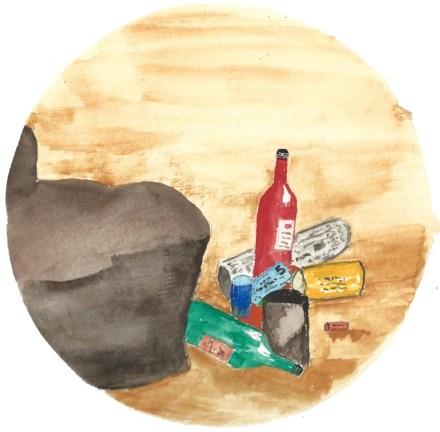
LITTERED BEACH

Can you find the red bottle?

**********

Madi and Josiah and their parents took bags and began their task. With all four at work it didn’t take long and soon they came to the big rock.

There, nestled under the worst irresponsible mess of abandoned bottles and bags was a new five pound note.  Five pounds was just enough money to be interesting but not so much that they might have worried about trying to return it. They decided to set it aside in case the family returned the next day and after that they recalled what Mr. Cameron had said,

“Finders are keepers.”

HIDDEN MONEY

Can you see the hidden money?

**********

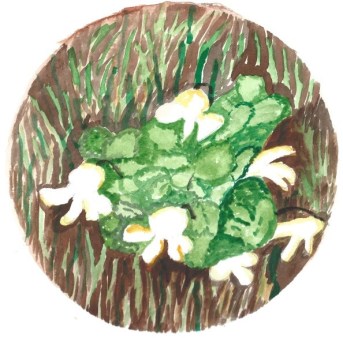
The following day there were more day-trippers and after they left, the whole family eagerly collected trash. Their father even walked half a mile across the bay to investigate a small white object nestled in the far rocks. He explained that he thought that it might be more money but when he got close he saw that it was a white flower.

The following weekend was the same. The family was so diligent that Mr. Cameron gave them a special accolade when they departed the next Monday.

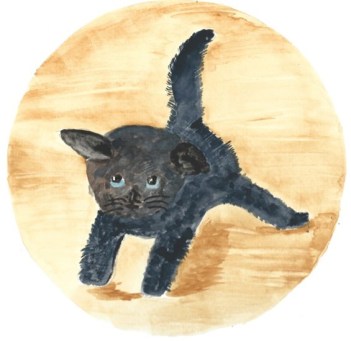
He offered them one of the black kittens, from the cat’s litter as a reward for their collecting all the day-tripper’s litter. The children enjoyed petting it but their parents said that kitten was too young for their long drive home.

ONE KTTENKIT

Did you spot the flower on the hill on page 9?

What would you name the kitten?

**********

Two days after the family left Mr. Cameron entertained his neighbor, Mr. Morrison. He also had a coastal farm and also augmented his income by opening his beach to day-trippers and campers. As they stood looking over the beach before supper Mr. Morrison commented,

“Your beach is so clean. How do you do it?”

Mr. Cameron pointed to the big rock,

“Someone always picnics there and so I incentivize my campers.”

“You what?”

“I incentivize my campers! First I ask them to help to keep the beach pristine, and then, on the first day, I slip a fiver in the litter next to this rock. After they find that money nothing can stop them. It is the best investment ever!”

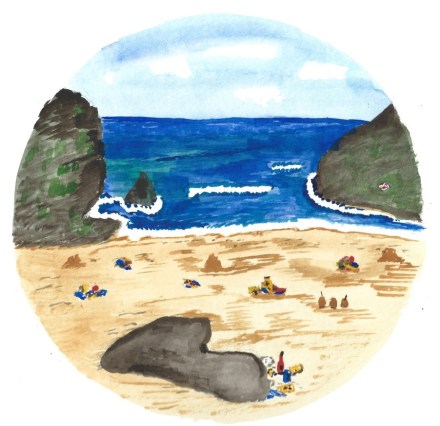
CLEAN BEACH

The beach is clean.

 What color is Mr. Cameron’s sweater?

Great-grandma’s Story – a short story

On Friday, June 13th 2012, Anna sat on a pillow on the floor in front of great-grandma Alma Hofer. She leaned back to rest gently against great-grandma’s shins. It was early afternoon on a hot Austin, Texas summer day, but the room was cool and dim with blinds pulled and air conditioning humming. Anna drew up her knees and relaxed. In her hands she clasped her favorite stuffed bunny; every so often she touched his silken ears to her lips. Quietly great-grandma began to give her a head massage. The massage was gentle, almost as though butterflies were wafting against her scalp. Great-grandma’s massages were always this way so soft that at first one doubted that it could be of any benefit, but as it continued one became lulled into a happy trance in which her touch gave exquisite pleasure. Anna relaxed and let the kind old fingers ease away her tensions and soothe her. She was glad to be old enough to be excused taking a nap like her younger sister, happy that her quiet time could be spent sitting here enjoying her great-grandma’s love.

“Tell me a story, grandma,” she asked. “Please, tell me a story about when you were a little girl.” Anna found it difficult to visualize her parents, grandparents and great-grandparents as children but she still enjoyed their childhood stories. She closed her eyes and tried to imagine great-grandma as the young girl in her photograph album rather than the eighty-nine-year-old great-grandma against whose shins she leant. She touched the bunny’s ears to her lips again as she waited in anticipation for her great-grandma’s gentle voice.

“When I was a little girl of about eight, as you are now, I had five brothers and sisters. The last two were yet to be born to bring the count to nine. We lived on a farm in South Dakota. We did all the same things that you do. We prayed, ate, slept, grew, went to school, played with the other children, and did our chores. Life was never dull, for our world was changing as fast as yours changes.

“At home we spoke German, the language that our great-grandparents had brought with them from their origins in Europe, before their century in Russia. School was conducted in English. This was hard for some like your great grand-pa who, after his first week at school, said to his mother (in German)

‘They keep pointing me and saying ‘sit down please’. What does that mean?’

“We prayed every day morning and night and at meals with a special trip to church on Sundays. When I was little we went to church with a horse and buggy and we put the horse in a special barn at the church while we prayed. Until I was five we used to stay at church all day. The families took turns in providing the lunch which was always home baked Zwieback, jam and coffee.”

“What is Zweiback?” murmured Anna.

“Zweiback is sweetened bread enriched with eggs that is baked and then sliced and toasted until dry and crisp. It is like the Nabisco teething biscuits that your mother gave you when you were a baby. The jam was whatever we had; my favorite was, and still is, ground-cherry jam. We gathered the wild ground-cherries where they grew in hedgerows and along the edges of the fields. By the time that I was six years old we had modernized and had cars and so we stopped staying at church all day.

“You like to play, little Anna, and so did I. We played hide and seek like you do; it was especially fun in the horse barns at school and at church. We played ‘Stealing sticks’. In this game there were two sides each with ten sticks. You had to steal your opponent’s sticks without getting caught. If you were caught, you became a prisoner with the opposing team’s sticks and hoped that you would be rescued by your team. We played bat and ball, a game similar to softball. We played Pump, Pump Pull-away. This game began with one catcher, and runners running from one side of the playground to the other. When anyone got caught they also became catchers, until it was impossible for the remaining runners to get across the space without being caught. In the winter we played fox and goose. In this game we drew a circle in the snow with an inner circle as the safe place for the geese. We usually had two catchers or foxes.

“My older brother Paul was a big boy for eleven, so he and one of the siblings sometimes did the hay mowing. It was fun to sit up high on the hay mower and to guide the horses as they pulled the sharp sickle over the ground, leaving a trail of sweet smelling cut grass behind. We were always careful to keep out of the path of the sickle because we knew that it was heavy and sharp.  The blades could easily cut off a limb or the heavy machinery crush anyone in its path. One summer day Paul was mowing the top field with his sister when she noticed that one of the horse’s lines was caught on the horse’s bridle bit. The horses were very gentle but as you probably know, they don’t like surprises, especially surprises from the side. It is best to approach them from the front so that they can see you coming.

“Paul could see that the caught line was a problem and that it would hinder the horses when he turned, so when he got to the end of the line he asked his sister to get down and untangle it. She was comfortable up top and didn’t want to climb down and go around the horses. She looked at the tongue of the mower which went between the two horses. She knew that she was agile and proud of it. She was so agile that she sometimes showed off walking along a beam or the top of a wall with ease. She decided to walk down the tongue between the horses and to reach up and untangle the line. She was on the tongue before Paul realized what she was doing or could think about the danger. Once she was there he couldn’t say anything for fear of spooking the horses. If she were to fall and the horses moved, he knew that the mower would go over her and that the weight of the machine would crush her even if the sickle gear lever was raised.

“When she got to the tangled line she gave it a gentle pull and it came loose. She was about to edge her way back up the tongue when a bird flew overhead and squawked. One of the horses turned his head and saw the girl standing on the tongue. He panicked and began to move, which spooked the second horse, who also moved. In the next split second much happened: the girl fell between the horses into the path of the mower, and the horses took off pulling the mower behind them. Paul, still on top of the mower, hung on for dear life.

“Horses generally go for home, and this is what the frightened team did. They raced towards the barn, their hooves pounding the ground and leaving a cloud of dust behind them. The noise frightened them further, and they picked up speed. When they came to the farmyard they tried to run between two small buildings. Here, the sickle bar got caught and stopped them. The noise brought mother and father into the yard. Paul screamed,

‘My sister, my sister, the mower went over my sister.’

“Mother began to cry and ran up towards the hay field. Father and Paul followed her. They all knew in their hearts that there was little hope and dreaded the scene that awaited them. I sat up just as they arrived – for I was that little girl. I had bumped my head on the tongue when I fell but was otherwise unhurt.

“There was no easy explanation for the miracle of my escape. Mother speculated that a large stone next to where I fell had made the mower jerk into the air and thus miss me. She also said that I should take it as a lesson that showing off mars good judgment.”

Late Home – a short story

The sisters enjoyed their drive home. They thrived in each other’s company and had much to be happy about. As they exchanged dreams they agreed that prospects were good that New Year’s day. The party in Edinburg had been a success with a classic Scottish celebration. During their hundred-mile drive home they had plenty of time to make plans’ only regretting that they had started off late and would not be home until 3pm.

The red Volkswagen which they drove was their mother’s. She had lent it to them accompanied by the strict provision that they return it by 2 pm. They knew that they had promised, but didn’t consider an hour to be so critical; the worst, they reassured each other, would be one of her dramatic tongue-lashings. They expected that she would give them half an hour of berating. It would be half-an-hour in which she told them how irresponsible they were, how disappointed she was, et cetera, et cetera. They knew the routine and looked forward to the aftermath when they would apologize and kiss and make-up and their transgression would be forgiven and, more important, forgotten.

They were still giggling and happy when they parked the car in the garage next to their father’s Rover. They were a little surprised to see it parked there as he generally returned from his clinic later in the day. They accepted this break in his routine as a good sign, giving an additional boost to their joyous stance. They walked down the drive to their home with happy raised voices. Their father met them at the door, his normally calm face, which generally cracked a faint smile when he greeted them, was bathed in disappointment.

“How could you girls break your word?” he asked. “She had to leave your brother next door with neighbors and call me to come home. Then she had to walk to Dr. Shaw’s office. You know what a long hike up hill that is. How could you girls do that? How could you?”

“We didn’t know. It was only an hour,” hazarded the oldest, although, even as she spoke, her heart sank for she knew that her father was a stickler for honesty and for keeping one’s word. The younger knew that such an excuse wouldn’t appease him. She thought of Rudyard Kipling’s poem If framed on his wall and the maxim of honesty and perfect reliability which formed the foundation of his code.

“It doesn’t matter what you knew, you broke your word. You failed. This is not the behavior that I expect from my daughters.” His accusation carried sadness and disappointment tinged with anger. They shuffled uneasily from foot to foot, knowing how much his approval meant to them and how miserable they were, standing before him, having failed. They both wondered what they could say.

The elder volunteered, “Can we go and pick her up?”

But, just then the telephone rang. Their father answered it, “Durham 43068, Dr. Stevens speaking.” The sisters couldn’t hear the other end of the line, but, from his pallor they both sensed that something critical had happened. “I’ll leave at once,” he said. “I’ll be there in fifteen minutes.”

When he placed the telephone back on its cradle he sighed, “That was Dr. Shaw.” he said. His voice quivered; something his daughters had never witnessed before. From his face they both thought that he looked as though he was going to cry.

“What’s wrong? Is it Mom? Is she alright?” the elder asked.

Their father seemed to be taking his time in answering as the sisters watched the grandfather clock behind him ticking second by second. When he spoke, his voice was quiet with no anger in it, just an intense sadness.

“Dr. Shaw says that he suspects that it is an advanced colon cancer. Your poor mother, she had to walk to the appointment alone.” He paused and put his hand up to his face, shielding his eyes from their view. His voice rasped out, barely a whisper and yet full of intensity, “We all, and I do mean all, let her down, both you girls and me. I should have been with her.” Again he paused and now his voice was a little louder, almost a gentle wail, “She is my wife and she received this prognosis without me. I should have been with her.”

Taking their cue from him his daughters immediately wanted to cry; their mother had always seemed so full of life. What did this mean? How should they react to this change in the year’s prospects?

The following is advice, which no one gave the sisters. It is advanced to all those in similar circumstances:

“When you hear the news, act immediately. Don’t deny this event in trivia for it will change your life forever. Accept the inevitable, and take instant action. Quit your pressing education, career, and normal obligations; leave them behind and go home. In less than a year you can reassume your life with ease: right now your dying mother needs your love.”

“Sit beside her in the garden room among your father’s red fuchsia; enjoy the last whiff of her Fleurs De Rocaille. Talk to her about her beliefs, love her. Of course you love her, but does she know it? Did you show her instead of telling her? Show her when you cook her favorite foods. Let the house teem with the sweet aroma. Coax her to eat. Read with her, listen to her voice and ask her about her life. Immerse yourself in her precious last days. For this short interlude of time savor her life, by forgetting yours.”

© July 2015 Jane Stansfeld

The Location Variance Board – a parable

By 2025 the City was stifled by its own success; as evidenced by seemingly unsolvable traffic congestion. It had freeways and mass transit, in the form of trains and busses; it had travel restrictions, and mandated work schedules; yet bumper-to-bumper ‘rush hours’ persisted. The name ‘rush hour’ was a misnomer on two counts. First because there was no element of ‘rush’ in the crawl of the traffic. Second because no one, in their right mind, could use the term ‘hour’ to describe the congestion in which the morning commuters’ slow movement mingled into the snarl of homebound evening travelers. This meant that, if asked, no driver could pin-point when the proverbial ‘rush hour’ began or ended. All agreed that, in 2025, traffic was a problem and, shaking their heads, announced,

“Something has to be done about it”.

In the 1980s and 1990s the City’s phenomenal growth had been a source of pride. Residents bragged to their out-of-town friends and relatives quoting the daily influx of new residents as proof of the desirability of their urban home. They waxed lyrical, and talked about the green belts and protected environmental features carefully blended into the urban fabric. The City Council managed to skillfully blend environmental protection with their invitations to new industries and employers so that the influx of new residents had meaningful jobs. They kept unemployment at less than 5%. The happy residents declared,

 “It’s the quiet blend of nature and City which makes our City quintessentially our City. It’s what we love about it. Some say that it is also weird, to which we reply, keep it weird!”

It is hard to imagine how the happy City of the twentieth century could have let itself evolve into the congested nightmare of the twenty-first. Outsiders asked why the elected City leaders hadn’t invested in more mass transit, more freeways, and more corridors for movement, of times called roads. The answer is, unfortunately, a criticism of the way the City functioned. It is an answer which, even in 2025, no resident wanted to accept. The answer is that the City had allowed itself to become compartmentalized into neighborhood groups.  Each group operated a small fiefdom and savagely protected, what they viewed as, their ’rights’. They objected to: the widening of roads, to the increase of density, to the loss of green space, to anything which, they felt, took away from their comfortable immediate environment. If challenged, by an outsider; we note here that only an outsider would dare to do this, no elected City official wanted to risk their electoral support. If challenged, each neighborhood group would have answered that they didn’t see why they had to give up their hard-won rights; they would say,

“Why can’t someone step in and solve the problems of the overall community; perhaps those fat-cats in the elite neighborhoods?”

One spring morning in early April 2020 the residents’ attention was grabbed by a twofold disaster. A fire in a semi-suburban apartment complex burned out of control because the fire engines from the nearest fire station were trapped inside by stalled traffic, while other nearby stations, which ought to have been able to send equipment to help, were unable to respond for the same reason.  The entire complex of several hundred apartments was burned to the ground. Fortunately there were only four fatalities as most of the residents were out in their cars in the traffic. The second disaster was equally sad; a City Council member fell on the City Hall steps and died before an ambulance could get to her aid, again because traffic was at a standstill.

After a time of mourning and fruitless soul-searching, which did nothing to solve the neighborhood stand-offs, Mary was elected to take the seat of the deceased council woman. Mary, a native of the City, now lived in one of the new high-rise condominiums in downtown and could walk to City Hall. Isolated, as she was, from the daily immediacy of the traffic congestion, she might have chosen to ignore the problem; however, the opposite was true, she was acutely aware that the boa constrictor of traffic was suffocating her beloved City.

Mary’s first proposal was a suggestion that the City mandate a four ten-hour day week. This passed quickly as many welcomed the idea of an extra day off. However, it had no impact because everyone merely added Friday to their weekends. Next Mary persuaded City Council to mandate that the extra day off rotate between employers. A complex set of rules were developed. Traffic got better. People complained, but were happy to spend less time on the roads. Their pleasure was short lived and, in a few years, traffic was as bad as ever. Mary stepped in again with the suggestion that the City mandate rotating business hours. This initiative received endorsement as it was what many were already doing in an attempt to circumvent the worst traffic; as a result it had moderate success.

Mass transit, you readers are mumbling, mass transit is the answer, and I, the writer, agree. But, and of course, there is a ’but’; but, you see, the neighborhoods were still looking out for themselves and wouldn’t allow transit intrusion into their sanctified confines. City Council launched mass transit initiatives at every election. Each time the proposal was defeated in deference to full-out attack by whichever neighborhoods felt threatened. Residents quoted the sanctity of their homes and environmental protection while each privately thought,

“Yes they should use mass transit. It’s the answer. They should use it. Yes indeed, they should, but, no, not me, not near my house. I need my private car. Always have, my needs are quite unique; not me!”

Mary’s initiatives had delayed the inevitable by almost ten years, but by 2030 the City traffic was unbearable and our lovely City was beginning to experience a modest population decline. This had never happened before. City Council worried about loss in revenue and the neighborhoods hated the ‘for sale’ signs along their streets. By now our enterprising Mary was mayor, and as the senior City leader she proposed a new initiative. She proposed that the City be divided into wards, which followed the neighborhood boundaries and that residents be mandated to work no more than a certain distance from their homes. She managed to get this initiative passed by giving it a sugar-coating. Those who complied with the rules paid slightly reduced property taxes, those who didn’t, paid on increasingly high percentages. To address the populaces’ objection to the, what they considered, privileged ‘fat cats, in expensive close-in neighborhoods, these residences were offered no tax breaks while being heavily penalized for travel. Workers in fields which demanded location changes, such as maintenance and construction were given automatic exemption.

The caveat, which Mary offered vociferous objectors, was that the City was to set up a ‘Location Variance Board, (LVB)” whose sole job was to evaluate resident’s requests for variances from the location mandate. Given this seeming loophole the neighborhoods accepted the new ordinance. All thought that they knew how to handle City Boards, for, hadn’t they ruled the Board of Adjustments (BOA) for years? They speculated that they would come behind any non-compliant resident and prevail over the LVB while penalizing those in rival neighborhoods. They were in for a big surprise for the LVB, true to its mandate, only cared about traffic, and evaluated each application on its own merit. Commentary from supporters was politely heard and summarily dismissed.

Slowly, over the next decades, the once powerful neighborhoods changed focus. The citizenry came to realize that they were part of a bigger whole in which the good of their individual domain was inextricably woven into the collective good of the entire city. They championed the neighborhoods to allow densities to increase, transit ways to be built and watched with satisfaction as their City, once again, became mobile and an exemplary beacon for others. Eventually there came a time, long after Mary had retired, when the LVB could be disbanded.

An Epiphany – a short story

Mother paid off the taxi and she and I climbed steps up to the front door to the building in which Dr White’s office was located. The elegant terrace of Nash houses swept away in repetitive harmony as the buildings shone regal and impressive in the morning sun. I paused to look up at the Georgian fan-light over the door while Mother rang a bell and we waited to be buzzed in. The fan-light was a six segmented half circle with little circles in the empty spaces. I would have liked to draw it except this visit to Dr. White was too important to allow any delays. He was the London specialist we had travelled over 300 miles for an exclusive consultation.

The suite was on the second floor. When we entered we found it to be even more sumptuous and elegant than we had expected. It was the summer of 1964 and this was the first time I had been in the office of a private doctor, one who was not part of the National Health Service. The luxury was expected and yet surprised me. A large bowl of stocks stood on side table against one of the walls their rich aroma permeated the room, while soft classical music wafted from somewhere. We gave our names to the receptionist and had barely sat down before a prim nurse stepped into the room. She introduced herself as Robyn and ushered us into the inner portion of the suite. Its decor was friendly and residential with dark wood paneling, elegant pictures, high ceilings and a gleaming polished wood floor. Robyn took my height and weight. I weighed in at 77 pounds. We confirmed that we were here to get Dr. White’s diagnosis as I was twenty years old and had still not reached menses. Robyn took my history meticulously noting down the information that when I had been given the pill as an experiment by one of my doctors in the north everything had functioned. I undressed and put on a robe. It was voluminous and did little to disguise my bony frame.

Dr. White came in. He was professional and quiet spoken and listened patiently before giving me a thorough exam. When he had finished he nodded and patted me on my knobby knees and instructed me to get dressed and said that when I was ready he would see us both in his office. His office was equally sumptuous and he sat behind a large desk. On the side of the room opposite the door were a pair of glass French doors opening onto a small balcony with a wrought iron guard rail. I gave them a quick glance before focusing my full attention on the doctor. He looked at us motioning us to sit as he gently shook his head. We complied and I returned his gaze staring into his dark eyes thinking how very dark they were.

“I agree with your previous doctors,” he said “I find nothing wrong.” His voice was reassuringly quiet and professional.

Somehow this is what I had expected but not what I wanted to hear. “But, there must be something you can do.” I pleaded, ‘Something, anything, I can’t go on being a freak without sexuality for the rest of my life.” My eyes clouded and I had to fight to prevent myself from crying in self-pity.

He nodded and gave me a hint of a smile, “Yes there are many tests which we could run and measures which might need to be taken but I don’t recommend anything until your anorexia nervosa is cured. When it is cured you should wait a year and then consider coming back to see me. I doubt that it will be necessary.”

“What do you mean?” I asked. I shifted forward in my chair to perch on its front edge and to look more closely into his darkest of dark eyes.

“You have anorexia nervosa,” He said, “Until that is under control and you have a normal body weight it is pointless to run any further tests.”

“Anorexia nervosa,” the strange words rolled on my tongue, “what is anorexia nervosa?” I asked. I glanced at my mother who was being abnormally quiet then gave my full attention to the doctor.

He smiled kindly and gave us a textbook definition.

Anorexia nervosa is a psychiatric disorder characterized by an unrealistic fear of weight gain, self-starvation, and conspicuous distortion of body image. The individual is obsessed with becoming increasingly thinner and limits food intake to the point where health is compromised. The disorder may be fatal. The name comes from two Latin words that mean nervous inability to eat.

The description fit. This was a moment of epiphany. Eureka, I had an illness with a name and already I knew that I could fight it. The words ‘The disorder may be fatal punched me in my flat chest – this was worse than lack of development. I smiled nervously. Dr. White got up and shook mother’s hand. Then he took mine and looked me in the eyes. “Take care of your anorexia and everything will function normally. It’s that simple.”

As we walked down the steps to the building I realized the profundity of his words. Now I had an excuse, I wasn’t a disobedient daughter who wouldn’t eat. I wasn’t a naughty child to be spanked. I had anorexia nervosa and I could and would fight it.

And fight it I did – alone. At first it wasn’t easy, but gradually over the next year I managed to bring my weight up to 120 pounds. Slowly my body filled out and became more female. Menses didn’t come that year but we didn’t go back to Dr. White. I knew that there was no need. Over the next two years I gained another 5 pounds, until New Year’s Day 1969 my menses happened. I was twenty-three and a half. Dr. White had been right.

Amontillado – a short story

Tina stared out of her window at a sea of tree tops, green and gently moving in the wind. It always pleased her to be able to look out of this fourth floor window and see greenery even though she knew that at ground level she would be immersed in the bustle of suburban Houston. If she concentrated she was sure that she could see the huge oak tree, which her children had named “broccoli”, in her own garden. Her pleasant day-dream was interrupted when the telephone rang. She turned to answer it. Now the calm of the outside greenery was eclipsed and, as she talked, she gazed at the stained carpeted floor of Alfonso’s, and her, shared office. In the only, previously uncluttered, corner was a pile of broken down cardboard moving boxes. 

Tina looked at them with an aversion, so physical, that it made her slightly queasy. She admitted to herself that the boxes look pristine, and neat, when transformed from flat cardboard; but they are difficult to assemble and damage a girl’s nicely manicured nails. Her hatred extended further than the task of assembly. She would have liked to call in sick on this day to avoid the whole saga of moving. She knew that she would have to organize the piles of undefined papers in her office with its familiar mismatched furniture. Along the way a thousand decisions awaited, each one crucial, relating to what to keep and what to toss. 

By eleven on this Friday morning of the move Alfonso, was nowhere to be seen. This annoyed Tina, as she wondered if he was doing what she longed to do, or if he was keeping his normal happy-go-lucky playboy hours If he didn’t make it in she suspected that she would end up having to sort through his junk as well as hers and pack them both. Eventually she was happy to catch sight of him breezing in at eleven-thirty. He acted happy, as though he had had a liquid breakfast, and so, when their boss, Earl, suggested that he accompany him on a final inspection of their new offices then stop for a bite to eat, Tina suspected that he would be gone the rest of the day. Earl returned at about 3:00. He looked grim and dusty. He told Tina that the construction crew had disappeared leaving the limestone decorative feature wall incomplete. He explained that he had finished the last courses himself, to make sure that things were ready for the moving crew over the weekend.

“Alfonso isn’t with you?” asked Tina.

“Nope. We won’t be seeing Alfonso again.”

“Too much to drink?”

“I’d say so. I’ve had to let him go. He may be talented but, heavens to Betsy, it’s no way to run an office.” 

“So will he be in to get his personal stuff?’

“I don’t think so. We have seen the last of Alfonso. On Monday I’ll go over his projects with you and let’s see how much you can take on.”

The phone rang and Earl answered it as he dismissively walked away from Tina.

“Yes, I’m going hunting this weekend. I’ll be gone all weekend back late on Sunday.” 

Tina turned to survey the pile of cardboard on the floor beside her, she thought about Earl’s dismissal of Alfonso. It was certainly overdue but she did wonder why it happened on the day of their move so that she had to pack up not one but two piles of stuff. Alfonso was talented; indeed Tina had to admit that he had flashes of pure genius. She also knew that he had a problem with alcohol and frequently arrived late in the morning with an apparent hangover which he treated at lunch time thereby rendering himself useless in the afternoon. He was also a flirt and one noxious office rumor had it that, when Earl was away on business or hunting trips, he spent time with Earl’s wife, Irene, in their River Oaks ‘castle’. Tina had only been there once but she could understand the allure, if not for Irene, for the shear opulence of the place. It was built of Austin limestone inside and out and even sported a, rare for Houston, underground wine cellar. When Tina had visited Irene had graciously given her an unexpected tour of the cellars. Her tour focused less on Earl’s wine collection and more on Earl’s ‘raid’ shelter with its concealed entry and luxurious bedroom.

“Why on earth did he build that?” asked Tina 

“Some strange paranoia about tornados” said his wife. She gave a mischievous smile, “I let him do it, it’s my money, you know. I like it. Sometimes when Earl is away I sleep there hidden in its quiet luxurious secrecy. Nobody can hear you down there!” At that moment, Tina recalled, Irene had patted her arm and given a confidential wink.

Tina cut her reverie short. She packed Alfonso’s things into boxes which she neatly labeled by project. She separated out the personal stuff which she packed into two boxes labeled ‘personal’. For some strange reason she held back his address book and a pile of personal notes with her things. If Alfonso was not going to return to the office ever, perhaps by moratorium from Earl, then Tina thought that she might try to get these to him herself. 

She watched her colleagues going through the same routine, and saw a pile of trash by the suite entry grow until it almost blocked their way out. This Friday might be their last day in this uncomfortable over-crowded office; yet, despite their discomfort, they all felt a twinge of nostalgia. They would miss the old place with its familiarity and memories; miss the downstairs delicatessen where they liked to congregate for lunch; miss the rickety stairs where they panted up five flights in deference to ‘keeping fit’, and, yes, miss the musty smell emanating from their dusty piles of old documents.

Monday morning they drove new routes to work, found new parking spots and rode a pristine granite shrouded elevator to their new office suite on the fourteenth floor of the high rise about a mile from their old place. They had new ‘open-plan,’ top-of-the-line, Herman Miller modular furniture with matching fabric covered chairs and upper storage ‘flippers’. The movers had been efficient and their boxes were all stacked neatly in each office. 

By noon Tina was unpacked and ready to get back to work. Earl had Alfonso’s boxes stacked up against the interior feature limestone masonry wall adjacent to Tina’s work-station. He sat down with Tina and went over her new assignments. As they talked she saw him take long glances at the pile of Alfonso’s boxes. Tina felt mildly overwhelmed that she was to inherit Alfonso’s prestigious work. She detected something wrong with Earl and found his general demeanor disturbing, especially when he took glances over her shoulders at Alfonso’s boxes. 

That evening Tina stayed late to catch up with her clients. In the quiet of the evening she heard strange noises. They seemed to emanate from the wall behind Alfonso’s pile of boxes. The sounds were irregular as though they were being made by a living creature. She thought that some of the muffled wails could be being made by a gagged person. She called out,

“Who’s there?’

The only response was a scratching noise. It was muffled and could have been claws or finger nails dragged over a rough surface. She wondered if there were be rats in the building. She walked around the wall and deduced that there was a space, presumably a mechanical chase, enclosed by the decorative masonry. She looked under desks but found nothing. She told herself that she was watching too many horror stories and who-done-its and so, a little perturbed, she went home.

When she arrived early in the office on Tuesday morning she startled Earl who was standing gazing intently at the pile of Alfonso’s boxes. He had a strange twisted smile on his face. She immediately noticed that Alfonso’s ‘personal’ boxes had disappeared. She greeted him, ready to make an observation about the missing boxes,

“Good morning, Earl.”

“Yes, huh, good morning.” The response seemed dismissive and uncharacteristic of Earl so Tina decided not to mention the boxes. Instead she went to get herself a mug of coffee out of the office’s new Kuerig machine. As she went her mind raced – could this be an Amontillado story with Alfonso somehow encased in the wall perhaps lured there by Earl? The concept was too preposterous and yet it kept nagging at her all day. She watched Earl who appeared distracted and kept viewing the pile of Alfonso’s boxes.

That evening, she stayed late again, and as soon as she was alone she heard the strange scratching. She talked to the cleaning crew who surveyed her quizzically. They accompanied her to Alfonso’s pile of boxes and agreed that the noise was most peculiar. They confirmed that there was no evidence of rats in the building. Together they called the building security guard. The guard, a heavy-set no-nonsense type, reluctantly came and listened. He voiced, what they all were thinking,

“Building’s new – can’t be a ghost. Building is too new for rats. I’d say that it sounds as though there is something alive inside that wall.”

“What should we do about it?” queried Tina. Before the guard could answer she went on, “You know what I think, I think that we should get someone to open up that masonry and see what’s in there.”

“Go ahead, be my guest.” said the guard. He stroked his hipster gun with his hand, but made no attempt to offer any additional help.

Tina gave up and went home. She worried all night. The following morning she found that Earl was out of the office at a client meeting. Tina discussed the noises with her colleagues. When everyone stopped talking you could still hear an occasional faint scratching inside the chase wall behind the boxes. Tina took it upon herself to call the contractor who had performed their build-out. She asked them to send someone to open up the wall to determine the source of the noise. She felt a sense of urgency. At the latest the wall might have been closed up on Friday and it was now Wednesday morning five days later. Rather a long time for anything, or anyone, to still be alive in there.

By eleven the contractor arrived, moved Alfonso’s boxes, set down some protective plastic and opened a hole in the chase wall. Nothing. They shone a light into the cavity of the chase – nothing. Tina was beginning to feel mighty stupid when a scrawny cat emerged. It was thirsty but otherwise seemed in good shape. Tina knew that she would adopt it; and determined that she would name it Alfonso.

*********************************

The disinterring of Alfonso, the cat, might have been the end of our story but Alfonso, the man still haunted Tina. Over the next few weeks several items of personal mail arrived for him and she decided to deliver them to his apartment. When she got there no one answered the door. She went to the leasing office who confirmed that he was late with his rent and that they were about to evict him. They latched onto Tina and together they went and opened the apartment. The inside was untidy and un-kept but also looked like a place to which someone intended to return. The weeks-old fruit on the counter was rotten; and the open PC on the coffee table still running. It gave the immediate impression of a place abandoned without foreknowledge. Tina began to suspect the worst.

Tina decided to go through Alfonso’s address book and find if he had any relatives. She found his mother’s address in Toronto. She called and asked for news of Alfonso. His mother sounded forlorn and distant. She told Tina that she hadn’t heard from Alfonso for weeks and that he had missed her birthday, which was a first for him. Tina suggested that his mother ought to file a missing person report.

Several weeks later the police arrived at the office. Tina glanced at her calendar and estimated that it was now two months since their move. The plain clothes police inspector spent a long time with Earl in his office, and left with the parting words,

“Don’t worry sir, we will find them. In the meanwhile stay in contact and do not leave town.”

Tina wondered who the ‘them’ were. She went to talk to the office receptionist, who always knew the office gossip,

“What’s up? Those inspectors said ‘we will find them’. Who are ‘them?’”

“Didn’t you know? Have you been so busy with Alfonso’s clients that you didn’t hear the gossip? Earl’s wife, Irene, has disappeared.” She nodded confidentially, and lowered her voice to a hoarse whisper, “Well you know that she and Alfonso were close and now he’s also missing. Put two and two together and you get an elopement!”

“Are you joking?”

“No I’m serious. Of course I think that the police might suspect foul play and who has better motives than Earl. Irene was the one with all the money. I’m sure that he would like to see the end of her! The last few years have been rough.”

Over the next weeks the police keep snooping around. They interviewed Earl’s hunting buddies and verified a firm alibi; they interviewed everyone in the office including Tina. Eventually they obtained a search warrant and searched Earl’s home. Again they found nothing amiss. The investigation was going nowhere. On their third round of questioning they had Tina come down to the station. She wondered why they were treating her like a criminal when all she had done was hold back some of Alphonso’s personal items; and be the first to go to his apartment. As she was escorted out she chatted freely with the young inspector.

“What did you think of Earls’ house? It is quite an edifice isn’t it?”

“Yep, and so much limestone makes you wonder if there could be any more left at the quarry!”

“Good thought but there is plenty; I assure you. And what did you think of the wine cellar?”

“Quite a hoard; makes you wonder how he expects to drink all that stuff before he dies!”

“I agree because I don’t think that he drinks much. So, what did you think of his basement ‘raid center’ with its satin sheets?”

“Saw no satin sheets. A basement ‘raid center’? I saw no basement ‘raid center’. What’re you talking about?”

Tina stopped and stared at him, “Then you must have missed it, the door is semi-concealed.”

The inspector looked surprised and grabbed Tina’s arm as he muttered, “Hmm, You give me an idea, we’ll have to go back and you must come with us.”

When they reached the basement wine cellar Tina looked for the door to the raid room. She couldn’t find it and began to doubt herself although she was sure that she remembered what Irene had shown her. “Wait,” she said, “it was here. Now there is a stack of wine bottles over the place.”

They moved the bottles and their associated shelving system to one side. Their labors brought them no closer to an answer for the masonry behind looked continuous. Tina ran her hand over it and inspected the joints. She was beginning to perspire with nervous energy as she wondered if her whole episode with Irene had been a dream. She stood back and squinted at the wall and that’s when it came into focus and she was able to see a faint outline of the old opening. She heaved a sigh of relief and pointed.

“It’s there.” she said “Open up the masonry there.”

They called for tools and soon were demolishing limestone. Tina had been right a door came into view. It was locked. A key hung beside the door jamb. Perhaps they died quickly, maybe in their sleep of asphyxiation but there they lay on the glorious satin sheets locked for eternity in each other’s arms. When everyone had begun to recover from the shock of the opening the inspector looked at Tina.

“I know that he is innocent until proved guilty, but how did he do it? How did he lock ‘em in when he was out in the woods on a hunting trip with his buddies?

Tina looked at him and hesitantly answered, “Simple, the lock is electronic as is the ventilation system for the room. I’m sure that you will find that both have remote controls. All that’s needed to operate them is a mobile phone!”

© April 2015, Jane Stansfeld.
Rattler – a short story

After David and Judith tucked their two granddaughters in bed, Judith searched the internet for information about Rattlesnakes. She was happy to find that their rented Spring Break condominium had internet. Soon she was on line and able to learn that there are many varieties of rattlesnake, including ten different species in Texas alone. She read that the Western Diamondback (Crotalus atrox) is the snake credited with most of Texas’ serious cases of venom poisoning. Her research seemed to indicate that this was the snake to which the signs next to their beach access path on Mustang Island referred.

“Beware Rattlesnakes!
Do not walk in the sand dunes.
Stay on the boardwalk.”

The next morning a sea fog greeted them as they stood on their third floor balcony gazing at what should have been a beautiful view of the Gulf of Mexico. They could see the boardwalk gently climbing over the dunes but, at its apex, all they could see was white fog. It silhouetted the grasses and plants on the top of the dunes but completely masked the ocean beyond. They could hear the roar of the waves mingled with the call of seagulls, and smelled a salty wetness in the air; but otherwise they could have been anywhere. The girls were ready for adventure, so they were soon walking the boardwalk toward the shore. Judith made sure that everyone read the rattlesnake sign and added her own warning that rattlesnakes are not to be trifled with.

They played on the beach all morning. David dug a hole and Judith and the girls sculpted the pile of sand, which he created, into a ‘sea monster.’ No one was sure what a sea monster might look like on the beach but they had to admit that it bore a remarkable resemblance to a crocodile. By lunch-time a sea breeze had blown up and the fog was gone but it was cold on the shore so the girls asked to swim in the condominium’s heated outdoor pool.

Hours later, when they returned to the beach, someone had reworked the sea monster into a magnificent sand sculpture of a snake entwined around a sand castle. Its head at the apex had an exaggerated carved eye which convinced Judith that the sculptor was a real artist. The girls rushed up to destroy the sculpture. Judith intervened, she said that she liked its art and pleaded with them to leave it unspoiled. For some strange reason she saw it as an embodiment of Moses’s carved snake on a pole used to prevent death from snake bite among the traveling Israelites.

Instead, they played ball, sometimes kicking the ball close to the dunes,

“Don’t get too close to the dunes,” warned Judith, “I don’t want anyone to venture into the dunes.”

“It looks OK to me.” said David; but he still remembered his own encounter with a rattler of almost fifty years ago. The event was as vivid to him today as on the day that it happened. Although he knew that the story was not new he had to tell it. He derived vicarious pleasure in the narration.

“One college summer vacation, I worked on a road crew. It was hot dirty work! But that’s what you did back then!” David nodded at his audience to make sure that they were listening. They nodded back; they knew the tale verbatim. “As I was saying; hot, dirty work. One day I was walking through the desert scrub when I almost stepped on a basking ratter. I heard a hollow sound like the dry rattle of old bones. It was the rattler’s tail. Just in time, I looked down and saw a huge snake poised in a strike position”.

“How big, how big?” asked the children. They knew that the rattler got bigger with each narration.

David stretched his arms wide, “Oh about this, maybe six feet long. So, I looked down and saw a huge snake poised in a strike positon. It must have been yea long – perhaps six feet and fat!  I froze with one foot aloft. While I balanced motionless on one leg I stared ahead and tried to avoid its eyes. For a long time the snake and I remained motionless. There was no sound except the scary rattle of its tail. Then it dropped its head and just slithered off into the adjacent grasses.”

The two grandchildren knew the conclusion to David’s story and now both stood on one foot nodding with serious faces. Judith watched the children. She wondered what they were thinking. Her nocturnal research had told her that the best defense against a rattler is immobility just as David had done. She hoped that should either of the children meet a rattler they would act likewise.

The next morning was windy with a clear sky and warm sun. They decided to fly kites. They tried to assemble the kites at the widening of the boardwalk right before it descended to the beach. One of the kite struts slipped out of its package and fell through a gap in the boardwalk planks. David, without thought of the rattler warning, slipped between the boardwalk guardrail bars and climbed underneath to retrieve the piece. Judith watched in disbelief. What would happen if David encountered a snake? Surely the hidden place under the boardwalk was a perfect place for baby rattlers. Baby rattlers also have venomous strikes but before they shed their skins they have no rattles. Judith watched in anguish but all was well and David emerged with the missing strut.

It took them some time to get the kites aloft because the wind was so strong. When they deduced that the kites needed extra tails as ballast things went better. Initially they tried attaching sea weed but then discovered that the long thin packages that the kites had come in made excellent tail extensions. Indeed, they discovered that these extensions could be adjusted by the addition of sand. Everything was going fine with two kites aloft and the kite strings fully extended when one of the girls dropped her tether. For a moment it looked as though the kite might fly off on its own, but instead it took a nose dive into the dunes.

David didn’t hesitate. He ran to the boardwalk and when he got to the part closest to the lost toy he scrambled through the side of the boardwalk and walked toward it. As soon as Judith realized what was happening she ran up the boardwalk to be as close as possible. She was about to call out a warning when she saw him glance at her. He didn’t wave, but turned and continued on toward the toy. Suddenly, just before he reached his goal, he stopped and stood motionless with one foot in the air. Judith had often seen him balance thus in the gym.

© Jane Stansfeld April 2015

The Intruder – a short story

When a house is fifty or more years old it has many secrets locked within its structure. There are happy times, births, new babies, children’s voices, family gatherings, laughter, dinners, general everyday living and celebrations of good news. Inevitably there are also sad times, accidents, sicknesses, losses, commiseration of bad news and deaths. Each event is absorbed into the fabric of the house; into the walls and doors, into the stair treads and risers, into the newel posts, into the floor and roof beams, and even into the window frames and glass. At night, when every-day events of the present are hushed, the astute awake insomniac may hear whisperings of these memories; a door slams shut, a stair creaks, a strange noise emanates from the attic, a shadow flits across the glass, the musty smell of age morphs into the odor of fresh bread wafting from the kitchen. In this respect, the house, named Hilltop, was no different; so that when Lilly and her family bought it in 1955 they had no false expectations. Indeed Lilly privately thought that what the house lacked in aesthetics might be made up for by ample stored character. She was un-phased, indeed fascinated by the occult, and longed to discover Hilltop’s secrets.

Lilly’s desire was unspoken and she, along with the rest of the family of five professed to be drawn to the house because of its size which trumped its lack of beauty. The size was impressive, spread between two high-ceiling floors and an attic, it had five bedrooms, one-and-a-half bathrooms, and five main floor ‘living rooms’. These spaces were neatly encased in an almost featureless red brick cube, which, contrary to its name, was not on the top of the hill. When it had been built it probably had been the highest structure in the area, but over the years every available space on the hill was sub-divided into lots, so that houses sprang up to quietly make a mockery of Hilltop’s name. Hilltop scorned the newcomers, luxuriating in expansive gardens which unfurled down the hillside and in a magnificent view across the valley to Durham Cathedral.

The seller told Lilly that Hilltop had been built, in 1901, by a builder for himself. Although the builder must have been able to see the beauty of the Cathedral’s architecture he, being immersed in construction, was more interested in its longevity and stability. He had the materials at hand and so he made the house’s exterior walls in fifteen inch solid masonry, and the roof and floor timbers from six-inch wide lumber with depths varying up to twenty-four inches.

Lilly and her family moved-in in late December. The house groaned with an impenetrable icy cold. The little family discovered that walls without insulation, even walls of fifteen inch solid masonry are not good insulators. Lilly had the coal cellar stocked with local coal and built fires in the fireplaces, happy that there was one in all the major rooms. Over Christmas they began to redecorate the interior. In one of the front rooms, which they planned make their library, they found five layers of wallpaper, a layer for each decade of the house’s existence. When they exposed the original plaster they found a name and date scribbled on the surface. In two lines it read:

1900
Joe (45)

Lilly’s family was delighted, each child asking permission to add their inscriptions, which they did. Each added their age, starting with the oldest:

1955
Mary (12)

Lilly and her husband added theirs, although Lilly, always coy about her age, only thought that she inscribed:

1955
Lilly

The next day when the painters arrived, and Lilly showed them the wall, she was astonished to see that all the names now had ages after them starting with:

1900
Joe (100)

And ending with herself:

1955
Lilly (45)

No-one in the family admitted to having touched the wall since their initial signing session, so Lilly eventually became convinced that perhaps she had, in a rash moment, included her age. In her rationalization she thought that she could have been mistaken about Joe’s inscription; she just wasn’t sure what she wanted to believe. When she inspected the writing she was almost thought that she could see a faint 45 below the 100. It didn’t escape her that the original 45 plus the intervening 55 gives 100. Could this inscription be part of the house’s stored history or was Lilly merely forgetful and overly imaginative? She instructed the painters to paint the wall and the mysterious notations were rapidly covered by light green paint.

Neighbors came to call to welcome the newcomers. Lilly struck up a friendship with Helen who lived in a house further up the hill and directly across the street. In addition to her welcoming role Helen was on a mission. She was heavily involved in a number of philanthropic enterprises. She dearly wished to recruit Lilly. There were many options, ranging from, ‘Meals on Wheels’, hospital and prison visits, to a ‘Big Brother’ youth program. Lilly selected ‘Meals on Wheels’ and also undertook to ‘adopt’ an old person to visit in the old people’s home / hospital. Every time that the women met Helen talked of the many needs that she was trying to meet. She was especially proud on Julian, an eleven year-old youth whom she had befriended and who spent occasional weekends at their home. Each time that the subject was raised Lilly demurred on getting involved with youth; after all she pointed out, she had three children of her own to worry about.

Over the next years Lilly occasionally noticed strange unexplained nocturnal noises; a rustle in the attic, a creak of the stairs, a moan of wind around the eaves, or was it the wind? One 1960 autumn Sunday morning, her attention was grabbed in a new way, for she came downstairs to the distinct smell of smoke wafting from the library. As an ex-smoker she determined that it was a not the smell of coal burning but the distinctive odor of cigarette. She breathed in deeply to savor its hidden pleasure, and waited for her husband to come down ready for work. When he did she calmly approached him:

“John, do you smell cigarette in the library?”

He gave her an odd look and went into the library, “It does smell of cigarette,” he agreed. “But it’s not me.” His rejoinder was emphatic as he shook his head. A moment later he paled and turned to face his wife, “The smell is one thing, but now I suggest that something very odd is going on for my drink cabinet door is ajar and,” he reached and opened the cabinet, “and, yes it almost looks as though someone has been taking a swig of my whisky. The cap is off.” His hand trembled as he reached and screwed on the cap, “I never leave the cap off.”

“Are you sure?”

“Yes I’m sure.’ Then, seeing his wife’s amazed, almost frightened stare he added, “Well, perhaps I did leave the cap off last night, very odd, it would be a first.”

“Let’s check to see if someone could have got in – a loose window an unlocked door.”

They checked but found nothing unusual so they gently approached their children and their cleaning lady. After a few days they became convinced that the whole thing was reasonably explained by natural events.

A Sunday morning three weeks later they again smelt cigarette smoke, this time accompanied by a cigarette butt in the grate and a dirty whisky glass on the mantel. They both suspected an intruder but the doors and windows were all secure and why would someone merely smoke and drink and not steal anything? This was when Lilly voiced her growing private concern,

“Do you think? Do you think, that maybe, well maybe, our nocturnal visitor is some-one from Hilltop’s past?”

“Are you suggesting a ghost? Surely you aren’t suggesting that are you?’ John looked quizzical and then added, “It can’t be a ghost; for surely ghosts don’t drink or smoke. I thought that they, if they exist, are ethereal – like smoke themselves.”

“Well who knows, maybe this one does smoke and drink. Certainly he seems harmless enough, but I don’t like the thought that, even if he is harmless, he is in here drinking and smoking while you and I and the children are upstairs asleep. And then there is the issue of the writing on the wall. I’ve never been fully convinced that someone or something didn’t change the wall overnight.”

‘Well, do you want to stay up and watch?”

“No not really, but I suppose that we ought to.”

Over the next two weeks Lilly and John took turns sitting in the great reading chair in the library watching overnight. They saw nothing. Everything remained peaceful. Eventually fatigue and realism checked in and they abandoned their wake, to return to their normal routine. On the Saturday morning after their abandoned watch John was in his garden pruning dead-heads off the roses. Over the fence he watched Helen escorting a young man into their house. She had her arm around his shoulders. John mentioned his almost scandalized observation to Lilly. She responded with an explanation that the young man was not Helen’s lover but an ‘at risk’ youth whom she had befriended through the ‘Big Brother’ program. He occasionally spent the weekend at Helen’s.

The following Sunday morning they came downstairs to a library which had obviously been used by someone during the night. There were several cigarette butts in the grate, an empty whisky glass on the mantel and a couple of automobile magazines lying on the floor. As usual there was no evidence of forced entry. This time Lilly called the police. They arrived in two squad cars and powdered surfaces to take finger-prints. Lily said nothing although she privately wondered whether ghosts leave fingerprints. In this case there was an ample supply of good ones. The police suggested that they change the lock on the front door to a dead bolt. The existing lock, they explained, could be easily bypassed by anyone using a plastic card.

During a follow-up interview with the police John had an epiphany.

“Haven’t all our visitations been on Saturday nights?’ he asked.

“Well, yes, it has always been Sunday mornings when we found things amiss. You are right it is always on Saturday nights. So?”

“So, don’t you see? Helen’s troubled youth visits on occasional weekends spending Saturday night in their home – or maybe, more accurately, a large part of Saturday night in ours.

© Jane Stansfeld March 2015

Madi and the Monkey – a short story

Inside the hospital compound, past the guard station, the road split. On the east side of the ravine a branch curved up a steep incline to the hospital; on the west side the other branch spiraled up an equally steep slope to the residences. The first structure that the residence access road served was a duplex with a long, upper-level veranda overlooking the road. A little girl stood next to the guardrail. It was just past sun-rise and she enjoyed the relative cool of the morning before the Honduran day’s heat and humidity set in. She took her post seriously as she considered it her job to greet the people using the road. Those coming up were women who worked as domestic help in the homes on the hill; those going down were hospital staff also going to work. In the distance she could hear the faint hum of the ocean; nearer she could hear tropical birdsong; loud squawks, calls which seemed to say ‘peek-a-boo’, and crow’s caws. These sounds didn’t interest her for the noise which got her attention was a roar, from the ravine. It was the voice of a Howler Monkey. The monkey interested her as much as the people on the road, and she determined that in the evening she would ask her daddy to take her on a ‘monkey hunt’.

The monkey was temporarily forgotten when Reyna came around the corner of the road. Immediately the child waved and added her high-pitched voice to the cacophony of sound,

“Hola, buenos dias!”

“Buenos dias,” came the reply.

“¿Cómo estás?”

“Bien.”

“Adiós.”

They had now exhausted the extent of the small girl’s Spanish, but she felt good about the exchange. She turned and caught sight of Dr. Dan, the visiting urologist, and his wife. He wore blue scrubs and backpack. He and his wife had dined with the little girl and her parents the previous evening. Now they hurried to the hospital to donate a day of patient care and surgery. He would perform necessary, often life-saving surgeries, most of which he once performed in the United States before the advent of Laser and modern technologies. Now, in this remote hospital, with minimum resources, his skill was invaluable.

“Hello. Good morning,” the girl shouted. She waved and jumped up and down in excitement on the terrace.

Dan and his wife paused and smiled. They waved.

“Good morning, Madi,” they responded. “Have a nice day!”

Madi could now hear her parents greeting Reyna and moving around inside the apartment. She knew that she would soon see them walking down to the road toward the hospital. Today her doctor parents were exhausted after twenty-four hours during which one or other had been on call. Her mother had sewn up a severe foot laceration caused by a machete; administered to a youth with gang-related stomach injuries; delivered a baby whose mother had severe postpartum hemorrhaging; treated a young woman with an abscessed tooth which would have to be pulled later; and administered to a child who was vomiting live worms. Her father had seen an equal drama: an almost comatose child who had eaten a poisonous fruit; a middle-aged man with several broken bones as a result of being hit by a car; a case of dengue fever which is a bone- and joint-aching illness similar to malaria; and a case of severe genital herpes.

There was a gap in the people using the road which gave Madi a chance to listen to the distant monkey. With her child’s acute sense of hearing she detected that he was now closer. She decided to greet him,

“Monkey, monkey, where are you?” Her high-pitched shout pierced the air.

Silence greeted her back, not even an echo. Her call was sucked into the essence of the dawning day. Just then a woman cradling a tiny baby stepped onto the balcony from the adjacent apartment. She murmured,

“Hush.”

Madi walked over to the dividing gate, “May I see? May I see the baby?” She asked in the soft voice which she used when talking to her baby brother.

The woman, an American pediatrician, crouched down to show Madi her minute bundle. The baby slept. It was a premature born to an epileptic mother; it weighed three-and-a-half pounds, smaller than Madi’s doll. The American doctor was personally caring for the baby to give it a chance of life. She fed it breast milk donated by two of the mothers who lived on the compound. The baby’s own mother was unfit and unable to care for it, and the hospital nurses ill-equipped to tend for one so small. This baby’s only chance of survival in the critical first months of its life was this pediatrician’s warm-hearted love.

That morning Madi, escorted by her visiting grandparents, accompanied her parents down their road to the entrance gate and up the other side of the ravine to the hospital. By now the Howler Monkey was in full voice again. The loud guttural sounds echoed through the ravine. Madi asked to see the monkey, but her dad responded that the monkey’s call is one of the loudest in the new world, and carries more than three miles; so, he explained, the noise that they heard might be being made some distance away .They paused to gaze into the ravine and saw waving palms, tall trees, luscious green growth, steep sides, and an eerie damp stillness not yet fully illuminated by the rising sun. Madi shouted into the wet greenness of the abyss,

“Monkey, monkey, where are you?”

Silence ensued, and so Madi and her family continued their walk up to the hospital doors where they bid goodbye. On the way back Madi and her grandparents watched activities at the gate into the compound. They saw armed guards talking to patients and their families as they arrived on bicycle, occasional motor scooter, and a few by three-wheeled taxis. One gentleman arrived on a horse which he tethered on the far side of the rutted dirt track of a main road. All vehicles were parked at the gate obliging everyone to walk up the hill. They walked slowly, each taking a paused moment to greet Madi and her escort. The horse rider, a dark sun-tanned old man with toothless grin, approached and greeted them with a flood of gentle Spanish. The only word which the grandparents understood was “Niña”. While they smiled at each other across the language barrier, Madi ran to the edge of the ravine. She shouted into the trees,

“Monkey, monkey, where are you?”

This time she got a response. There was a sound of braking branches, and a large monkey swung down from a tree and jumped onto the verge next to Madi. Although recorded as one of the largest new world monkeys at a probable twenty pounds, he weighed about the same as Madi; however, his demeanor and hair made him look much larger. He sat a few feet from their group, rumpled up his short snout, and flared his wide nostrils before opening his mouth and howling. The deafening sound, at close quarters, alarmed Madi, who drew back and quivered on the edge of the ravine. The old Honduran horseback rider deftly reached out and grabbed her before she accidentally fell over the edge.

In the ensuing moments much happened. Madi began to wail as only a small child can wail. If her utterance had been heard by the evaluators of the Guinness Book of Records they might have downgraded the Howler Monkey from his entry as the loudest land animal. The monkey must have felt outmaneuvered for he gave one last howl, his mouth wide open and his throat throbbing, then he leapt off into the ravine. Madi’s awed grandparents attempted to calm Madi while offering effusive thanks to the old man. He smiled, shook his head, and resumed his climb toward the medical help which he had come to find.

This fictional story is based on a real place. If you wish to read more about the everyday challenges on this hospital compound in Honduras visit “Inside the Hotzes Beyond the Border.” At http://hotzesbeyondtheborder.blogspot.com

© Copyright Jane Stansfeld March 2015

The Parasol

868 403 Udaipur Hotel parasol JS01

Alice and her parents were far from their home in America taking a sight-seeing tour of India after which Alice planned to stay on to do a surgery rotation at an Indian hospital in Bangalore. When they arrived at their Udaipur hotel a uniformed hotel porter met their car. He carried a huge parasol. The lining was deep pink and its top decorated with sequins, lace, and gold and silver thread. The decorations swirled around in a miasma of color. Somehow its decorated magnificence reminded her father of Indian trucks on which no square inch escapes adornment; while it gave Alice’s mother a chuckle as she thought of the Quangle Wangle’s hat:

“With ribbons and bibbons on every side,
And bells, and buttons, and loops, and lace”.

The hotel entrance began with a white loggia topped by three domes. After passing through this impressive structure you came upon a broad, vehicle-free terrace of highly polished marble. Along the side opposite the hotel structure was a decorated guardrail peacefully overlooking Lake Pichola and Udaipur’s famed lake palaces; the white Jag Niwas, where parts of the James Bond movie ‘Octopussy’ were filmed; and the Jag Mandir.

865 403 Udaipur Hotel DH03

OLYMPUS DIGITAL CAMERA

OLYMPUS DIGITAL CAMERA

Instead of walking directly to the hotel lobby, Alice and her parents strolled over to the lake-side of the terrace and paused to look at the lake. The mirror-like surface of the water reflected the magnificence of the two island palaces, effectively doubling their impact. The landscape beyond was shrouded in a hot haze. It was a magnificent view.

Alice was drawn to the Jag Mandir which served as a refuge for Prince Khurram, while he rebelled against his father. This was because Alice had already visited Agra and knew that Prince Khurram went on to become Shah Jahan. Not only was Shah Jahan the famed builder of the Taj Mahal he was also one of the greatest of the Muslim Mughal emperors. Under his rule the kingdom thrived and arts flourished. Alice found his story romantic and even asked herself whether such love, without an arranged marriage, would, one day, be hers.

Prince Khurram was betrothed to Arjumand (meaning princess) Banu Begum in 1607 when he was 15 and she 14. They were married five years later. Although she was not his first or only wife he is reported to have adored her above all others. She responded with equal love and was always at his side. He changed her name to Mumtaz Mahal which means “Jewel, or chosen one, of the Palace.” Throughout their nineteen happy years of partnership they were inseparable. She bore him 14 children and died in childbirth with the fourteenth. After her death Shah Jahan mourned and spent the next twenty years building the Taj Mahal as her mausoleum. Ironically this great and gifted man, who spent part of his youth in banishment, was destined to spend the end of his life under house arrest ordered by his son. His prison abode was an ornately decorated suite of rooms overlooking the Taj Mahal.

While Alice stood and gazed over the landscape the porter kept to his post and held his parasol over her. When he slightly shifted his stance she turned from the lake and looked at him. The sun was behind him causing her to squint against its brilliance. The effect was that she imagined the porter as an enticing blend of Prince Khurram and her boyfriend Lewis. His porter’s hat became a bejeweled turban and his uniform, white robes. She smiled at him tossing her head back so that her blond hair sparkled in the sun. Instead of avoiding eye contact he met her gaze and, even though his mouth didn’t smile, his eyes did. She blushed and noticed that his golden skinned hand, which held the parasol, was trembling. Had the spell of Shah Jahan and Mumtaz Mahal’s love infected the terrace across the span of four hundred years? Perhaps the surrounding haze-shrouded hills combined with the beauty of the lake had captured their love for eternity. Perhaps Udaipur captured it more effectively than the Taj Mahal where serenity, love and beauty is bombarded by tourists. If it had, Alice’s parents broke the spell by calling her out of her reverie. Quietly the three made their way into the hotel.

That evening Alice and her parents took a boat tour on Lake Pichola. The evening was pleasantly warm and the lake surface like reflective polished glass. They viewed the City Palace on the shore and the two island palaces from the water before stopping at a third island to enjoy its gardens in the cool of the evening. On the farthest shore you could see a flock of water birds rising and landing on the waters. Peace reigned.

Despite the beauty of the evening Alice was clearly unhappy. Her mother sent her dad to get some refreshments so that she could attempt to cheer her up.

“What’s the matter, dear?” she asked as they sat at a table under a flowering tree. “I know that the hotel has internet, and I’m sure that you used it. So, is it something to do with Lewis?”

Alice shook her head and looked at her mother. She turned towards the view to hide her moist eyes. Her mother gently patted her hand, “Cheer up, dear, we are in a beautiful place, shrouded with romance. Tell me your problem – sharing always helps.”

After a long pause Alice spoke, “It’s been several days – no e-mail nothing. So, I e-mailed his friend Charles. The e-mail works all right, Charles responded in a flash. He says that Lewis has taken a two week vacation. Doesn’t know where he has gone. Mom, a surprise two week vacation and he didn’t say a thing to me. It doesn’t make sense. What can be going on?”

“There, there, dear,” her mother squeezed her hand, “I’m sure that there is a simple explanation. Perhaps he had to go home or something – perhaps there is an emergency, perhaps his computer is down – it’s happened before!”

“But, a two week vacation?”

“Look, you got this from Charles, and we know that he isn’t the most reliable, don’t we? I’m sure that there is a simple explanation. Our trip is almost over so I urge you to enjoy yourself and put Lewis out of your mind for a few days.” Alice’s mother smiled weakly as her husband approached them carrying a tray of drinks. The refreshments seemed to cheer Alice up and by the time that they had finished their drinks she was putting on a good act. She even smiled weakly and declared herself ready for the gardens.

A young man approached them, obviously taken with Alice. They fleetingly wondered if he was the previously parasol-holding hotel porter; none of them were sure as he looked so different, out of uniform, in an immaculate open necked white shirt and pants. They momentarily accepted his interest and had him snap photographs of them silhouetted in front of the lake. After they had thanked him, in a form of dismissal, he trailed behind them while they ambled through the lotus ponds and rose beds.

The following day they took their time and so it was almost noon before they were ready to depart and stood at the hotel entrance surveying the sun-bathed terrace. Again, a porter, armed with decorated parasol, sprang from seemingly nowhere, so that when Alice stepped outside into the sun she was shielded from its intensity. She ambled over to the guardrail on the lake-side and breathed deeply as she marveled at the view of Lake Pichola.  While she was mesmerized by the view, absorbing its beauty and romance she sub-consciously heard someone approach them. Then the parasol quivered. Alice turned and looked at the hand holding the parasol above her head. It had changed; it was not the original golden skinned hand of yesterday, but a larger white skinned hand. It was a hand that she thought that she recognized. Could it be the hand that she thought that it was? She turned away from the view and looked up at the holder of the parasol. She exclaimed,

“It’s you! How did you get here?”

“It’s a long story, Alice. I missed you so. I had to come.” He smiled down at her, now embarrassed by the parasol and wondering how he could get rid of it so that he could embrace her.

“Is everything OK?” she asked when she sensed his embarrassment.

“Yes, yes,” he nodded. “I had to come. I came to ask you a very important question.”

© Copyright January 2015, Jane Stansfeld.